Wednesday, January 22, 2025

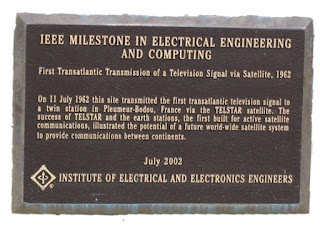
Telstar-1 – The First US Transcontinental Communications Satellite


Telstar-1 was an international effort providing trans-Atlantic telephone, data, and television services between the US and Europe. 
 Built by Bell Labs, it was launched by AT&T on July 10, 1962. The 34” diameter, 170 lb. satellite was launched into orbit from Cape Canaveral using NASA’s Delta rocket.  
 
Prior to Telstar, undersea cables were used for overseas communications.
 
It took about seven years to develop the new satellite technology, forever changing telecommunications.
 
On July 10, 1962, the first long distance telephone call using Telstar was between a former AT&T Chairman Fred Kappel and Vice President Lyndon B. Johnson, just a few minutes before the first Telstar transmission.
 
Good evening, Mr. Vice President, this is Fred Kappel calling from the Earth Station [ES] at Andover, Maine. The call is being relayed through our Telstar satellite as I’m sure you know. How do you hear me?”
“You’re coming through nicely Mr. Kappel,” responded the Vice President.

A couple of weeks later, on July 23, 1962, more transmissions occurred as Telstar-1 transmitted a Walter Cronkite news broadcast, a President Kennedy news conference, and a baseball game.  
 
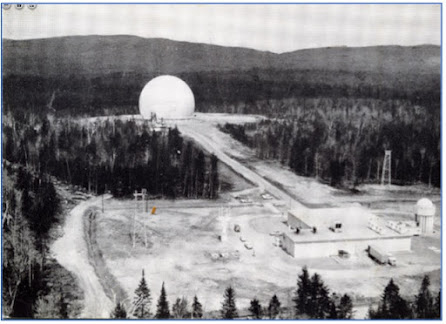
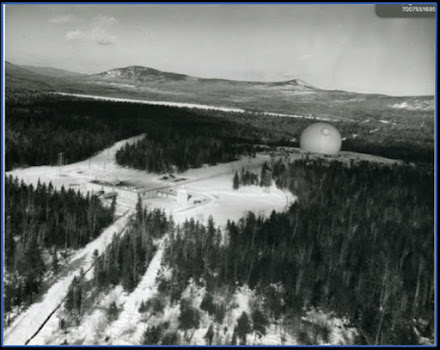
Initially, the satellite communicated between two earth stations, one located in Andover, Maine, and its twin station located in Pleumeur Bodou, France.  AT&T selected the Andover, Maine [Figure-3] Earth Station [ES] location in December 1960. Land was purchased in January, and construction completed before May 1, 1961. The earth station equipment was installed and tested, and ready for use in early 1962.   
 
The satellite consisted of a communications repeater, a telemetry system, solar panels and a power plant. The transmitter operated on the frequency of 4170 MHz while the receiver on 6390 MHz.  Its life cycle was designed to be operational for a minimum of two years. 
 
Telstar-1 is a low earth orbit [LEO] satellite [typically 200-300 miles above the earth]. Unlike a geosynchronous satellite [~23,000-miles], Telstar orbits the earth in an elliptical pattern travelling at a rate of 5-miles per second.  It was only usable every 2 ½ hours, having a 20-minute window where the two Earth Stations were able to communicate directly with the satellite when it was over the Atlantic Ocean.  

                  Figure-3  Andover, Me Earth Station
Linking Telstar telephone voice communications to the AT&T and Bell Telephone networks was by microwave radio and wired cable.  The first terrestrial microwave relay station out of the Andover Earth Station, linking satellite voice to the US continent, was to Black Mountain located in Rumford, which is about 4½ miles east.  The link was licensed in the 11 GHz frequency band. 

Site selection was based requiring the earth station to be in an area that had low signal interference [an RF quiet zone].  The area found and identified as the ‘Andover Bowl’ was selected as it was by surrounded with mountains. The terrain formed a bowl, shielding the earth station from potential RF radiation interference.  

Furthermore, the US location also required a short path to Europe, Andover also met this criteria and would be closer to Europe than other location in the US. The ES also needed to be close to the AT&T transcontinental microwave system for interconnection with the rest of the United States.


Note that the Black Mountain [Figute-4] communications tower, currently owned by SBA tower company, continues to be used today for Public Safety radio communications by the Oxford County 9-1-1 Regional Dispatch Center, and other cellular wireless companies.


Figure-4      Andover Earth Station Link to Black Mountain


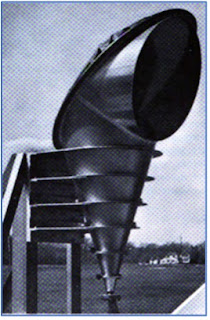
Note that the microwave antenna on the Black Mountain tower was a 5-ft conical horn antenna [Hogg-Holmdel] aimed at the Earth Station, and a 10-ft dish to the West Paris tower site with a 10’ x 15’ reflector.


Figure-7  Conical Horn Antenna used on Black Mountain


Connecting Telstar for overseas calls from the US mainland was facilitated by AT&T Long Lines, a large network of microwave tower sites delivering long distance telephone service to cities and towns nationwide.  AT&T Long Lines was the outgrowth of the telegraph system beginning in the 1850s, consisting of conductors on wooden poles.  
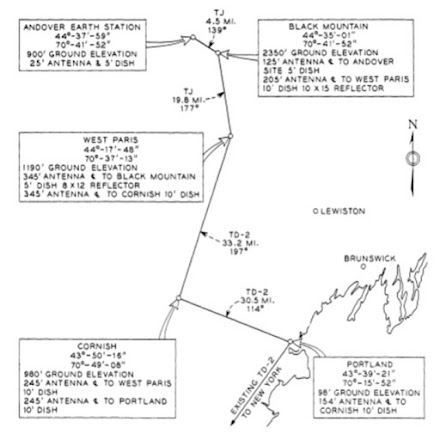


Figure-8 and 9   Earth Station Microwave Routing to Portland, Boston and Beyond


Beginning in 1911, and several decades thereafter, the AT&T Long Lines network provided wired long distance calls. With the progression of technology, however, AT&T Long Lines converted their landline system to wireless, replacing it with microwave radio relay towers [Figure-10].  


In 1947, AT&T implemented the first microwave system between NYC and Boston, using eight tower sites. From this point on, they built an enormous transcontinental microwave system carrying long distance telephone calls.  The first coast-to-coast call, using microwave radio, was made on August 17, 1951.  


Microwave networks require line-of-sight between towers.  This necessitates a large network infrastructure to deliver long distance phone service to all cities and towns in the US.  A local microwave tower site would be interconnected to the local Bell Central Office using cable [or microwave].  


Many 200’ to 300’ towers, about 15 to 25 miles apart, were constructed to relay telephone traffic throughout the country.  


This robust communications network, built by Western Electric, was relied on not only by the US public, but by the US government and the military for many of its communications needs.  AT&T telecommunications was considered critical military infrastructure, especially during the cold war.


As AT&T built the network, some equipment shelters were built underground like bomb shelters; some built to withstand nuclear blast EMP; some to withstand nuclear detonation, they all included emergency generators, while some locations were equipped to house technical staff needed to run the facility, the intent to keep the system operational if attacked.


Telstar was short lived.  Its brief life was about eight months; as its destiny was essentially settled by unintended circumstances, Telstar was launched in the middle of a turbulent electromagnetic radiation storm. 


The 1960s was also an important time in US history where the US experimented and tested nuclear bombs over the Pacific Ocean. Ironically, the day before Telstar-1 was launched, the U.S. set off a nuclear detonation test in the Pacific at an altitude of 250-miles. The blast was equal to a 1.4-megaton explosion, generating a massive electromagnetic pulse sending high energy electrons into space.


Besides being the first telecom satellite, Telstar was now an unintended experiment on the effects of a nuclear blast on electronics – in this case silicon transistors that were used in Telstar’s electronics.  


On the day of the launch, Telstar could not be activated as some transistors had failed due to the nuclear test. Fortunately, engineers at the Andover ES were able to recover operation by interrupting power on Telstar, which in effect reset the transistors and electronics on board. 


The next day they were able to successfully broadcast a picture of the American flag from Andover to the station in Pleumeur-Bodou, France.  


However, by December 1962, Telstar’s transistor problems continued, and the satellite stopped working again.  For the next month engineers worked feverishly to recover Telstar operations with some success as the satellite functioned again; but the electronics were unquestionably damaged, and AT&T decided to shut down Telstar for good on Feb. 21, 1963.


Today, nearly sixty years after the shutdown, Telstar is still orbiting the earth, and will do so for the next 200 years or so. Eventually, gravity will pull it back to the earth’s atmosphere where it will burn up.


In 1982, the Department of Justice broke up AT&T’s monopoly, allowing telecommunications competition. Microwave systems were continued to be built by other telecom companies, like Microwave Communications Inc. [MCI], allowing the technology and networks to grow. New generation of Satellites and Fiber Optics networks were being developed and implemented as primary voice and data transmission medium for the new telecom industries, especially in urban areas.  They provided greater capacity at greater speeds. Eventually, AT&T Long Lines began shutting down their towers in the 1990s’


As for the Earth Station in Andover, ME, it continues to operate today.  The original dome and antenna were taken down in 1985 as new technology replaced first generation equipment. 


Originally, there were plans to construct up to 50 Telstar satellites to form a constellation of low orbiting satellites, so that one would always be within sight of an earth station.  However, geosynchronous satellites were more favorable as they rotated with the earth, making it look like the satellite was ‘parked’ in orbit and always within sight. This position is 22,300 miles above the equator.


LEOs are far from being gone, they are expected to continue to grow into the next decade.  Companies like Starlink [Space-X], currently have about 3,271 LEOs in orbit providing internet services worldwide.
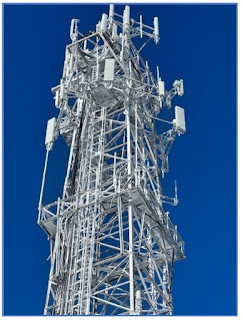


Black Mountain Tower Winter 2022 After Ice Storm


Friday, June 17, 2022

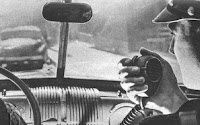
Calling All Cars! Calling all Cars!

Was this expression ever part of police radio dispatch lexicon?  Many think so.  However, Gerald Morris, Superintendent for the NYPD in 1937 described it this way:

Calling all cars!
“The dispatcher at the transmitter is the announcer.  He faces the microphone and it falls upon him to broadcast the signals to the men in the patrol cars. Entering the room, it will be very quiet.  No commotion, no yelling, in fact none of this hocus pocus of ‘Calling All Cars’ you see in the movies.  No police officer in any radio room ever uses the expression ‘Calling All Cars’.   It would only be a waste of time to say ‘Calling’. The cars know we’re calling them without being told. We just say, ‘Car 1211’ or ‘All Cars’.

We’ve all heard this phrase, and assumed that was used in the early days of dispatching patrol cars.   It origins perhaps is based from an old radio program, as well as movies and later television.

From 1933 to 1937, there was an early radio broadcast show called “Calling All Cars” [sort of like a Dragnet broadcast].  Each episode began with a simulated radio dispatch call that was introduced by a LA Police officer.  The show was a production of a true crime story of the day, describing the crime, telling how the crime was solved and how justice was served.

Early Police Dispatching
At the turn of the 20th century, a policeman on beat would use a telephone call box on the
Police Call Box
street to call headquarters for assignments or for backup if needed. [Sometimes whistles were used to alert colleagues in the nearby area].

This period also saw the emergence of the automobile, the automobile significantly changed how police conducted their operations, but also made contact with headquarters challenging.  In many places, the only way to communicate with headquarters was to install a lamp on a pole or building near a downtown area to signal officers. A roving patrol car would periodically drive by to check the status of the lamp. If the lamp was on, they would stop and call headquarters using a telephone call box.

Within 20 years, the radio too became a powerful weapon against crime.  Detroit first started using radio in 1927. By the mid 1930s, most large US municipal police departments were using radio for police work while many smaller communities were ultimately planning their own systems.

Radio changed things – while it took 20 minutes or more for an officer to respond to a call using the call box system, the radio reduced this to about 45 seconds [Thomas Rochester, NYPD radio engineer].  The automobile and the radio forever changed how law enforcement conducted operations.  In a 1990’s study, it was shown that police officers valued their radio more than they valued their service revolver.

Commercial broadcast radio first surfaced in 1920, with KDKA in Philly being the first to enter.  Broadcast saw incredible growth in the 1920s, and it didn’t take long before law enforcement officials saw its possibilities to fight crime.

During these early days of broadcast radio, some police departments used this medium to alert patrol officers of crimes in progress. The commercial broadcaster would periodically interrupt their regular entertainment programming to transmit urgent messages to officers on patrol.

Although this method was effective, mixing police emergency messages during a broadcast created problems for the police. People listening to the police broadcast showed up at crime scene - sometimes before the police did.  Of course, some criminals also listened police broadcasts to assist in evading police.

The City of Detroit spent nearly the 1920s decade working on radio problems. The early systems were one-way radio – a dispatcher transmitting messages to vehicles on patrol. Vehicles could not communicate back. However, in 1932 the City of Bayonne, NJ was the first US police department to install transmitters in their patrol cars thus having two-way communications.

First Use of Radio for Law Enforcement
Just a few short years earlier in 1901, Marconi transmitted his first transatlantic wireless message using Morse code – the letter “S”.  Marconi and early wireless exploration focused on ship to shore communications. By 1907, ships were beginning to install wireless sets on their ships. Cargo and passenger shipping companies saw this wireless telegraphy was not only essential assisting in the prevention of sea catastrophes, but also to help in sea rescues. Wireless telegraphy was also used to provide ship travellers with daily news. 

Ultimately, the Titanic [1912] proved that wireless communication was critical to shipping and all ships thereafter were required to have wireless telegraphy.

Hawley Crippen
It appears that the first use of radio in law enforcement for catching a criminal occurred in 1910.  Hawley Crippen, a Michigan doctor, murdered his wife while living in England.  Police caught him after finding out by wireless telegraph that he was on a boat heading back to the US with his girl friend that was dressed like a boy. The ship’s Captain, bound for New York, saw a newspaper article about them, became suspicious after seeing a “father and son” holding hands on the deck. The Captain used his shipboard Marconi wireless telegraph set to transmit his suspicions to the home office. The home office, in turn, reported to the police who then arrested Crippen and his girl friend in Quebec. 

The press was also alerted [by leaks] and the public was able to follow Crippen’s activities throughout journey through press reports, as it took several weeks for the ship to traverse the Atlantic.  The Captain even made friends with the Doctor and his companion, making several reports of their encounters using his shipboard wireless set.  Many consider this the first tabloid type drama, as the public was fascinated with this story because of the gruesome event and the ongoing Captain’s reports; kind of the precursor to today’s TV broadcast sensualizing the news event while it happens.
Cora Crippen

The story got lots of internationally attention and was considered a very important event for the upsurge of Marconi’s wireless technology.

Crippen’s wife, Cora, was an ambitious performer and opera singer, and used her sexual
attractions to advance her theatrical and singing career.  Cora mysteriously disappeared and Crippen told friends that she had gone back to the United States, had taken ill and died. He then foolishly invited his secret lover to move in with him.  It was thought that Cora probably had been murdered, dismembered; some say fileted, and then burned. Parts of the body were found. Crippen was arrested, then tried in a London court and was later hanged.  In recent times, with DNA testing, it appears that Crippen may not have murdered Cora.


Friday, January 28, 2022

Carterfone to Smartphone

"Here lies a stubborn Texan” is purportedly to be inscribed on Thomas H. Carter’s gravestone.  

Stubborn Texan!  Who is Tom Carter? Those of us who have used radiotelephones and radio pagers, then cellular telephone, and now smartphones are very thankful to Tom for allowing this to happen.
 
Tom Carter
But the road there was not paved!

Tom was just a radio guy, just like most of us in the land-mobile radio industry.  He loved this industry just as we do.  Tom owned a radio shop when land mobile radio was king. This was big business as police and fire departments, and all types of companies were using radio to communicate with their field staff – way before cellular radio or specialized mobile services like NEXTEL.

Tom’s radio shop was in Dallas, TX, called the Carter Electronics Corporation, starting business around 1946 when radio communications – wireless - began its skyward growth.  He also provided intercoms and other communications systems.  By 1959, his company was selling, installing and servicing 2-way radios systems in Texas and to a lesser extent in Oklahoma.

Tom owned a cattle ranch, and had been thinking about a solution to what he thought was a problem; that is, while on his horse riding fences around the ranch, or out working with his cattle, how can one make or receive telephone calls?   The phone was at the office or at the house.  Today, we just pull our cellphone out of the pocket to answer calls; actually, we may even check the Internet for something we’re thinking about or need to check on.  In the 1950s this was science fiction.

Early Carterfone
Tom was a true radio technician who was a problem solver.  In 1959 he found a solution to make calls while riding his horse, a device that patched the telephone network with two-way radio calls.  He called it the “Carterfone”.

The Carterfone worked this way:  when someone with a two-way radio in their vehicle, or a portable transceiver that wanted to talk to someone that had a telephone; the radio user would call his base station attendant at of the radio control point [FCC rules required that someone needed to monitor transmit audio and transmitter control], and tell them to set a patch to the called party.  The station attendant would then dial the phone number. When the recipient answered; they were informed that the call was a radio call.  The radio attendant then place the telephone handset onto the audio coupler cradle that was tied to the radio system. This “patch” allowed the radio caller and the telephone user to communicate directly.  The audio coupler was part of the Carterfone device, which used VOX [voice operated switch] that would automatically switched to the radio transmitter when the telephone user was talking.  When the telephone user stopped talking, the radio switched back to the receive mode.  The station attendant had a speaker to monitor the conversation and could adjust the audio with the volume control. Once the call was finished, the radio attendant would remove the telephone handset from the coupler, and then hang up to end the call when the conversation was completed.

This was a groundbreaking idea in the day. Now one could roam the ranch with their radio and make calls when needed.  Other ranchers, but especially oil-drilling companies were very interested in this system.  This included ambulance to hospital calls to easily communicate. No more telephone to telephone or radio to radio calls; the patch integrated the two systems.

Carter was the first to it!  Soon, he found that he was able to sell Carterfones just as fast as he could make them.  Life was good for all!
 
Carterfone
But hold on – You cant do that!  It’s not legal!

Well, at least that’s what AT&T thought. 

AT&T at the time had total control of their network, from any telephone handset to any other telephone handset and everything in between.  There was the local telephone operating company [e.g. N. E. Telephone], then there was AT&T Long Lines for long distance calling; Western Electric manufactured all of the telephone equipment, and all R&D was at Bell Labs.  Unmitigated monopoly!

The TV show “Laugh In” had a skit with Ernestine the telephone operator. She had AT&T labeled correctly:  “We don't care, we don't have to, we’re the telephone company”!

So AT&T began to harass Tom Carter’s customers, threatening them that if they did not stop using the Carterfone unit, AT&T would cease providing them telephone service.

The basis of their threats was based on FCC approved AT&T tariffs that stated:   No equipment, apparatus, circuit or device not furnished by the telephone company shall be attached to or connected with the facilities furnished by the telephone company, whether physically, by induction or otherwise”.  The basis for this that they wanted to protect their system from devices connected to their network that could potentially harm equipment.  Therefore, any device connected to the telephone system had to be provided by AT&T.

Tom’s radiotelephone interface was acoustical; that is, audio sound was transmitted into the mouthpiece of a telephone handset without an electrical connection.  The Carterfone’s cradle acoustically coupled both sides of the conversation via the telephone handset, which had a mouthpiece and an earpiece.  The device did not electrically interface with AT&T equipment – all Carter was doing to the AT&T system was sending sound waves to a handset mouthpiece just like any human would do.

The stubborn Texas cowboy believed that he was not harming anyone or anything, and that no one had any right to tell him that he couldn’t be in the Carterfone business.

Then, around 1966, and with AT&T threatening to discontinue service to Carter’s customers, Carter decided to file a private antitrust suit against AT&T.  However, the courts referred the issue to the FCC.

AT&T, a powerful US firm always had behind them with many politicians and bureaucrats in alignment.  This inflicted AT&T lawyers with various levels of haughtiness and arrogance.  These men were very smart and as they worked for a very important company.

And here comes this unsophisticated Texan, with his inexperienced Texas lawyers. AT&T lawyers saw this cadre as a bunch of amateurs to be thrown aside.  They were so confident and so amused by it all that they often laughed openly among themselves.

Long story short - the joke was ultimately on them. It was AT&T’s management and their attorneys who faltered in their performance of the case, due to over confidence.  The FCC would not be there for them this time around.

One of the AT&T star witness testified that a person could speak into a telephone receiver held at arm's length, or shout from across the room to the handset – this was legal use.  However, the use of megaphone [or other device] to project the voice over to the phone handset was illegal. Any intervening equipment to send voice onto their system would damage the network; thus not legal per the tariff.

FCC attorneys asked AT&T for details on how the system would be damaged.  How does an acoustic device damage equipment, as there is no electrical connection, just sound waves.

AT&T could not produce any proof or evidence. The ten or so AT&T attorneys in the courtroom just looked around at each other unable to respond. Here we were, several elite attorneys, a decade in court and no response – the FCC was upset.

The FCC was also troubled by the fact that telephone users could install AT&T manufactured equipment that had the same exact functionality that the Carterfone offered – but one would damage the system but the other would not, it didn't make sense!  No more could AT&T claim harm to the network; they would now have to demonstrate specific harm going forward.

One again, AT&T may have thought the FCC was on their side.  Not this time.  The FCC got burned by AT&T the earlier Hush-A-Phone case [1955].  This was another unreasonable court case that AT&T objected to a device “connected” to their system.
Hash-A-Phone

The "Hush-A-Phone," was a small rectangular plastic baffle placed over the mouthpiece of a candlestick telephone. There was a cavity big enough to place your mouth into. When you talked, the party on the other end could hear you clearly as the plastic device filtered office or room noise.  Carter also invented was the Hush-A-Phone.

Incredibility, it took the FCC more than six years to decide this case. And the decision was in AT&T favor!  An appeals court easily reversed the decision.  The court said that “..a telephone subscriber may produce the result in question by cupping his hand and speaking into it, but may not do so by using a device which leaves his hand free to write or do whatever else he wishes, is neither just nor reasonable..  The Hush-a-Phone decision was in 1955. This set up the stage for the Carterfone decision.

In the Carterfone decision, the FCC opened AT&T’s market to others for the first time. Equipment not provided by AT&T could interface with their network if certain rules were followed [FCC Part-68].

This ruling was major as it opened up the telephone network to others, like fax machines, answering machines, and ultimately modems for Internet access.  AT&T wanted to be the exclusive provider of this equipment.

Carter, the stubborn Texas cowboy, was willing to fight but did not fully recognize that AT&T was willing to drag this fight to the end.  His business fell apart and had to sell it.  He even sold his cattle ranch and home to pay legal fees fighting AT&T.  Carter got much moral support but no one helped financially.

Carter did settle the case in 1968 for $500,000 and the right to access the AT&T network.  The amount received barely covered his expenses. 

After 10-years in court, Carter was beat mentally and physically. He claimed he had ulcers and nerves, having to take medication.  Tom died in 1991 of lung disease.

AT&T was now on the defense, and in the not too distant future, a battle with microwave radio and long distance was brewing, setting the stage for the next level in the fight to break the AT&T’s monopoly.

Tom Carter, both with his Hush-a-Phone device and especially the Carterfone, was the first to pry open the strong control that AT&T had on their network, only allowing equipment they produced.  Now it was open for other to provide services not readily available by the giant AT&T.

AT&T has over 100 years of traditional telephone service, with the past 50 years or so adding data technology. They are now upgrading their network to be an all IP based telephone company.  In the end, the break up opened up applications and services for the consumer with AT&T still a strong company that was able to evolve keeping up with the advancement of technology and especially services.